

Bad Writing
It's not good. It's bad.

We are expanding our membership. If you want to be in the room with other executives who feel free to admit their own ignorance, let us know.
We are living through a cliche crisis. Bad writing is everywhere. It is so dominant that calling it out is its own kind of cliche.
Bear with me this week. I know what I’m doing.
I can’t stop thinking about an anodyne LinkedIn post I saw about two weeks ago. Like any other feed post, its value lives in the mind of its reader. The gist of it is that we are living in a golden age of writing, where natural language prompting can transform an author’s intention into executable software. In other words: coding syntax is giving way to clear writing.
If you are a writer, this should inspire you. I appreciate the point but am distracted by the package in which it was shared.
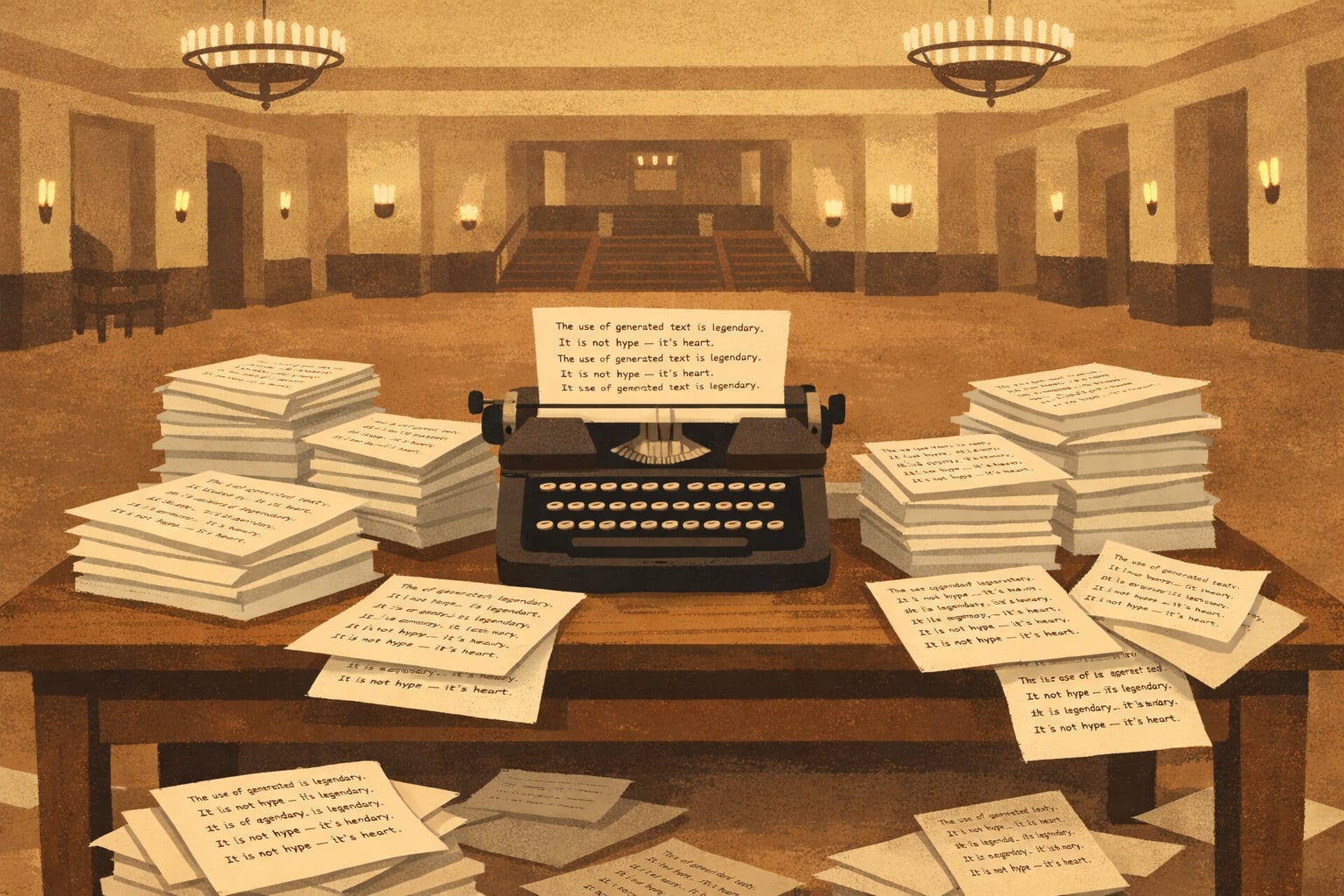
The irony of this post - from a thinker I genuinely admire and appreciate - is that it was very clearly a piece of generated text. The syntax, structure, and tone of this piece was indistinguishable from any other post you will find in your feed. It had the em-dashes, the not this/that framing. It made everything sound epic.
And that is the irony of our times. And this is the provocation of the week.
Provocation of the week
If this is the golden age of writing, why does everything sound the same?
By now it is a well-worn argument. A complaint about excessive em-dashing is as original as a cover-band’s hit. Nevertheless, it reveals something about what we are giving away with this technology.
Writing is thinking. Generated writing is generated thinking. A generated thought can never be considered original. The em-dashes are the canary in the coal mine of unoriginal thinking. The antidote to this issue is stronger editing.
Like this whole post, I am not making an original argument. This post by Laurence Pevsner on the Riskgaming Substack expresses it more directly. You should read it.
We covered this entire topic yesterday at ON_Discourse, in our most recent Follow My Flow series. In it, a prominent Substack author shared their own editing workflow. Here it is in short: a pdf version of the 1959 style guide by Strunk & White is stored in a Claude project with an extra set of instructions that will edit the syntax and style of their drafts without compromising the substance of their argument.
One line in these instructions stands out: “edit at the sentence level, not the paragraph level.” When pressed about that, this member said that higher-order edits from a LLM compromise the points and threaten to lose the thread of the thinking.
For that member, it is a bridge too far.
On its face, this type of AI customization works. This author is behind a best-selling Substack account. There can be no doubt this comes from quality syntax and, more importantly, original thinking. But this wouldn’t be an ON_Discourse post if I didn’t end it with some ambiguity.
Our session ended with a surprising turn from our host. For the longest time, the Claude + Strunk & White method served this writer well. The thinking came from the human and the sentence-level editing came from the machine. But then the model got better and the lines got blurry.
It all started in November, when Claude released Opus 4.5. Suddenly Strunk & White took a back-seat to some deeper collaboration. This member started feeding Claude their past essays and asking it to connect them to whatever they were working on now. The model could identify connections from pervious work and current moments that are amplifying the thinking. Little moments of context embedded in all of these archives were given a second life thanks to this model.
There is no going back.
And so I return to that LinkedIn post. If writing really is the new coding - if clear language is what builds the products and systems of the future - then we have a problem bigger than em-dashes. The quality of our thinking determines the quality of what we build. And right now, most of us are building with cliches.
(Claude helped me with the ending).
What’s Next?
If you have thoughts, feedback, or a perspective worth sharing, reach out: chmiel@ondiscourse.com. You might see your reaction in next week’s edition.
ON_Member Events
ON_Group Chats
From Journeys to Outcomes: The Next Era of CX
Thursday, February 5, 2-3pm ET
As agentic systems mature, experience moves from interaction to delegation. Core provocation: What happens when customers stop searching and start delegating?
Join Mathew Sweezey, Principal Consultant | AI Transformation, Monks and ON_Discourse members to learn more.
ON_Breakfast Club
AI, Wearables & the Awareness Economy
Wednesday, February 11, 9-11pm ET
Join ON_Discourse members, including AI leaders, builders, operators and invited guests for a private breakfast, illuminating discussion, and breathtaking views from the 69th floor of One World Trade.
This month’s discussion features Raashi Rosenberger, Head of Brand for Meta Wearables, exploring how AI-powered wearables are shaping the next phase of the awareness economy. As intelligence moves from screens into the physical world, wearables introduce a new idea: that awareness itself can become a programmable layer… one that influences what we notice, prioritize, and act on in real time.
The conversation will examine how this shift is changing human–technology interaction, redefining attention and presence, and opening up new design questions as AI becomes more ambient, contextual, and personal.
ON_Podcast
Dan, Toby, and Chmiel reunite after a long January to unpack what happened when ON_Discourse members went hands-on with Moltbot (formerly Claudebot, now OpenClaw) — an open-source AI agent with full shell access to your computer, your email, your calendar, and everything else. What started as an emergency Group Chat turned into one of the most unsettling Follow My Flow sessions yet, with even the most advanced members shutting the tool down because it got too weird.