

Moonlighting
Small ideas lead to big ideas

The internet is rapidly changing. It does not matter if you are a seasoned CTO or a first-time founder, nobody has a map for this. You need to connect with people who want to figure this out. That’s why we’re here.
The butterfly effect is real. I’m not talking about the Ashton Kutcher movie.
A TV script written and rewritten and re-re-re-rewritten for a short-lived 1985 series starring the future John McClane changed the way stories are told on television. Let me be precise about that: I’m not saying Moonlighting changed TV. I’m saying it changed the way we tell stories. And it all started with an insignificant detail.
The script was longer.
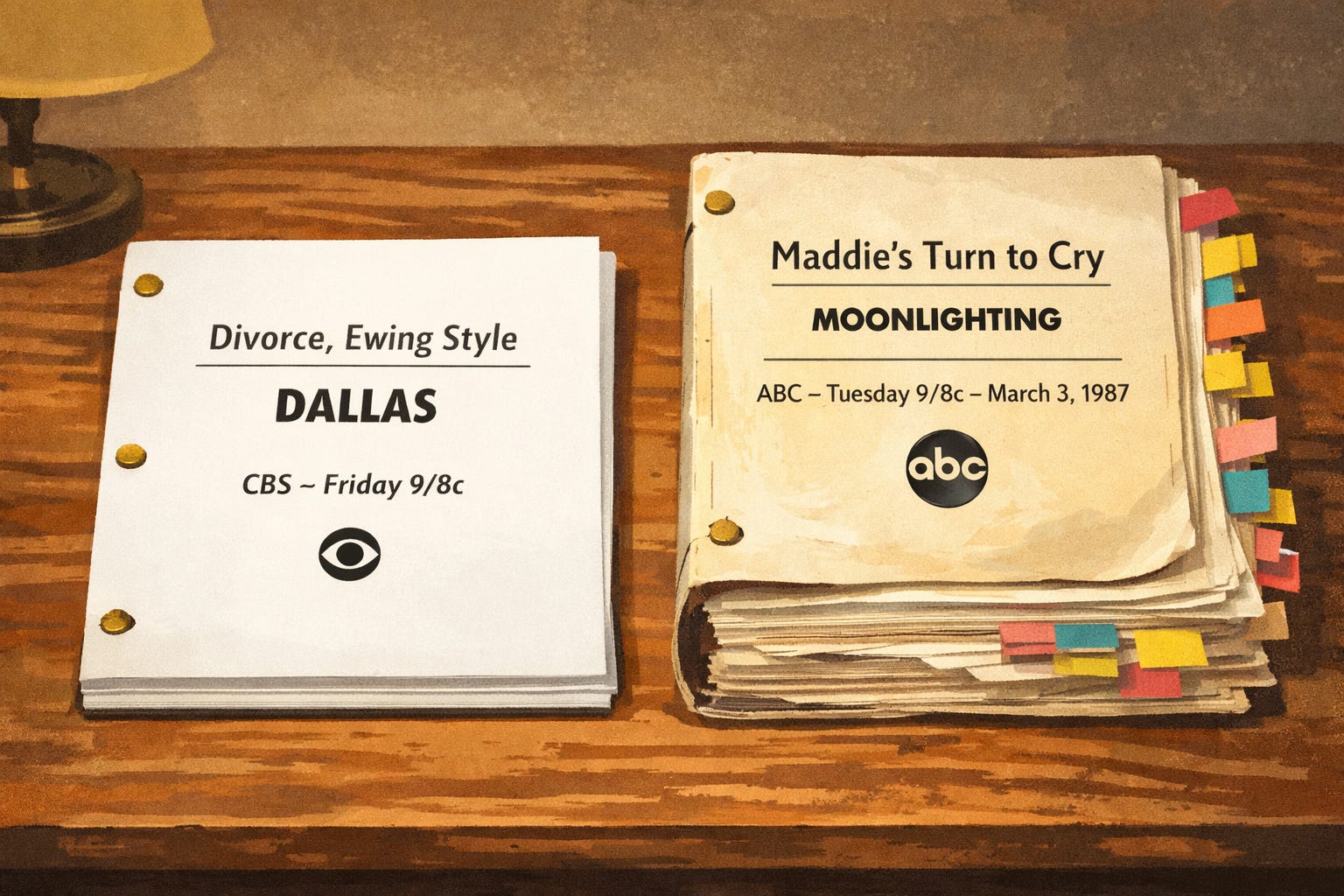
At the time, the average 60-minute TV script ran 60 pages. Moonlighting doubled it. On its face, this sounds like a trivia question without a point. Reality tells a different story.
The longer script gave more words to the characters, which gave them more things to talk about, which they used to talk about more complicated things, like feelings, which inspired new ways to represent those feelings, which unlocked ideas that traveled to new series on different networks, which created a chain long enough to reach Prestige TV like the Sopranos, the Wire, or… I dunno, Burn Notice.
All because the scripts were longer.
All this time we were looking for the innovation in the stars. Turns out the big idea was hiding in the margins of a sheet of paper.
This sounds like a provocation.
Provocation of the Week
The prompt box you use changes what you ask for.
By now you’ll know we’ve been consumed by the OpenClaw phenomenon. As Dan said on our most recent podcast: “It’s not real, but it’s important.”
That statement has two meanings.
The first: the security implications of OpenClaw are real. Giving root access to an agent is fundamentally risky, just ask this Meta AI alignment director about it. Beyond that, it’s janky tech. Daily updates mean the agent that worked on Monday will be buggy on Tuesday. We’ve hosted multiple events with OpenClaw true believers, even MSG, the founder of ClawCon, repeated this. The tech is complicated, dangerous, and confusing.
It’s not real, but...
It is one of the most consequential innovations of the AI era. It let you talk to your computer via WhatsApp. On its face the notion seems obvious and almost meaningless. The reality is much stranger.
We are not used to this.
Virtually everyone we know who has embraced this paradigm has reported the same unexpected thing: a cascade of new ideas that seem to follow them wherever they go. Not because the model changed. Not because the prompts got better. Because of where they are prompting. It unlocks new ideas.
Thinking about it makes me feel like I’m watching Moonlighting for the first time. It felt different. Electric. Nobody could explain why, especially compared to the standard dialogue of a Dallas episode, a program with dialogue so slow that playing it out loud actually makes paint dry.
Nobody predicted that longer scripts would eventually produce the tragic hero, the antihero, prestige TV, or any of the other innovations in storytelling that define what we watch today.
Nobody’s predicting what happens next with this one either.
What’s Next?
If you have thoughts, feedback, or a perspective worth sharing, reach out: chmiel@ondiscourse.com. You might see your reaction in next week’s edition.
ON_Member Events
ON_Claw & Order
The Agent Interface is Here!
Wednesday, March 11, 5-8pm ET
Join ON_Discourse, Domain, and Code and Theory for an old-school tech meetup to explore the new layer of the internet.
What happens when AI agents move from novelty to infrastructure?
Inspired by the rise of OpenClaw and what it represents, combined with the rapid emergence of persistent agent layers, this event brings together builders, operators, and AI fanatics, for live demos and candid discussion about a simple but profound shift: the browser is no longer the primary interface, the agent is. No panels, no theatrics, just working products, open interrogation, and a serious look at how delegation, mediation, and automation are reshaping our relationship with the web.
ON_Discourse is where C-suite leaders, investors, entrepreneurs and innovators come together to challenge assumptions, sharpen ideas, and drive transformation through discourse.
ON_Claw and Order is also supported by Domain, a collaboration platform where AI and people can work together.
ON_Group Chats
The Computer Is Dead (Long Live the Computer)
Thursday, March 12, 2-3pm ET
Early adopters aren’t buying computers to use them, they’re buying them to house an intelligence that works autonomously while they’re away.
In this conversation hosted by ON_Discourse and Code and Theory, Toby Daniels (Founder, ON_Discourse) sits down with Craig Elimeliah (Chief Creative Officer, Code and Theory) and Santi Pochat (VP of AI Innovation & Brand Strategy, Lenovo) to explore how the relationship between humans and hardware is fundamentally shifting, from passive tools to active partners.
Drawing on real use cases from the emerging agent community, they’ll examine what happens when your computer doesn’t sleep, why trust is the new spec sheet, and what it means for the brands building the next era of personal computing.
ON_Discourse Group Chats are live, high-signal discourse driven conversations with AI leaders, builders and operators.
ON_Podcast
Dan, Toby, and Chmiel confront a hard truth: a listener reached out last week and said they were completely lost. So this week, the trio tries to strip away the gobbledygook and explain — in plain language — what OpenClaw actually means, why it matters even though it barely works, and why none of them can confidently explain what they’re building anymore. Along the way, Toby uses his therapist as a test case for AI integration, Dan admits he might have been wrong about prompt engineering for three years, and Chmiel says something he never expected to say: everything feels broken.