


Toby here, stepping in for Chmiel, who’s on a well-earned vacation this week. Big shoes — bear with me.
What good is a Ferrari to a driver without a license? A telescope for someone who is not interested in space? A stack of AI tools to a company that can’t figure out who owns them?
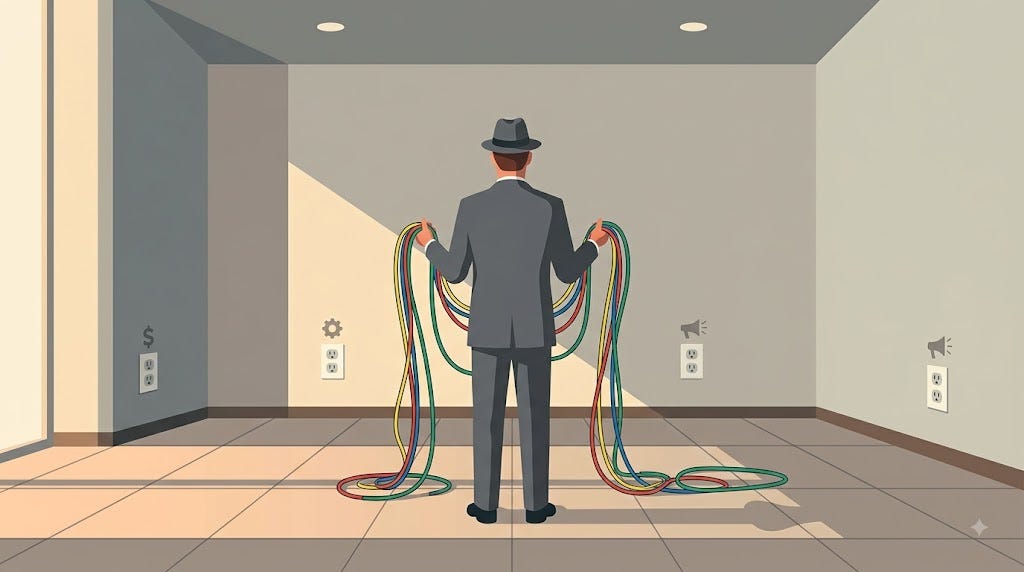
Somewhere between the demo and the deployment, the promise of AI turns sour. The CFO wants the ROI number. The CIO wants to own the architecture. The CMO wants the campaign live by Tuesday. And in the middle of that Venn diagram sits a stack of AI tools nobody agreed you needed, held up by a Zapier the intern wired six months ago.
Welcome to the orchestration gap.
—
PROVOCATION OF THE WEEK
The stack isn’t the problem. The org chart is.
—
Most C-suite leaders already know their AI stack is disconnected. Almost none of them agree on whose fault that is. The CIO points at Marketing. Marketing points at IT. Product points at whoever signed the vendor contract. The CEO points at “someone we hired for exactly this.”
Meanwhile the stack keeps sprawling. Projects get cancelled, not because the tech didn’t work, but because it is unclear who owns the outcomes.
The instinct is to add another tool. A better orchestrator. An agent to manage the agents. But the gap isn’t a technology problem. In fact, it’s an ownership problem dressed up as a tooling problem. Which is the kind of problem that vendors can’t sell their way out of.
In September, we’re going to interrogate this topic together.
—
ON_Member Events
ON_Discourse Breakfast Club: The Orchestration Gap: Stop Adding AI. Start Connecting It
Tuesday, September 9, 9-11am, NYC
New research from Code and Theory and WSJ is landing this fall that says the C-suite already knows the stack is fractured. What they don’t agree on: who owns the fix?
Join Toby Daniels and Michael Treff, CEO of Code and Theory who will open the room for an interactive conversation with the C-suite leaders wrestling with this exact challenge.