


Help us grow our audience. If you like this piece, please share it with one friend. Interested in joining our network? Click below.
Important ideas come in contradictory pairs. You know how it goes: it was the best of times, it was the worst of times.
Take AI discourse: it is simultaneously true that AI is changing everything about the world and also nothing is different. It is a sentiment our members hear and also say all the time.
How can a so-called epochal technology spread this quickly while delivering so little value? The data supports both sides of this claim. On one hand, AI is the fastest spreading consumer technology in human history. On the other hand, it is offering no material gains from companies that adopt it.
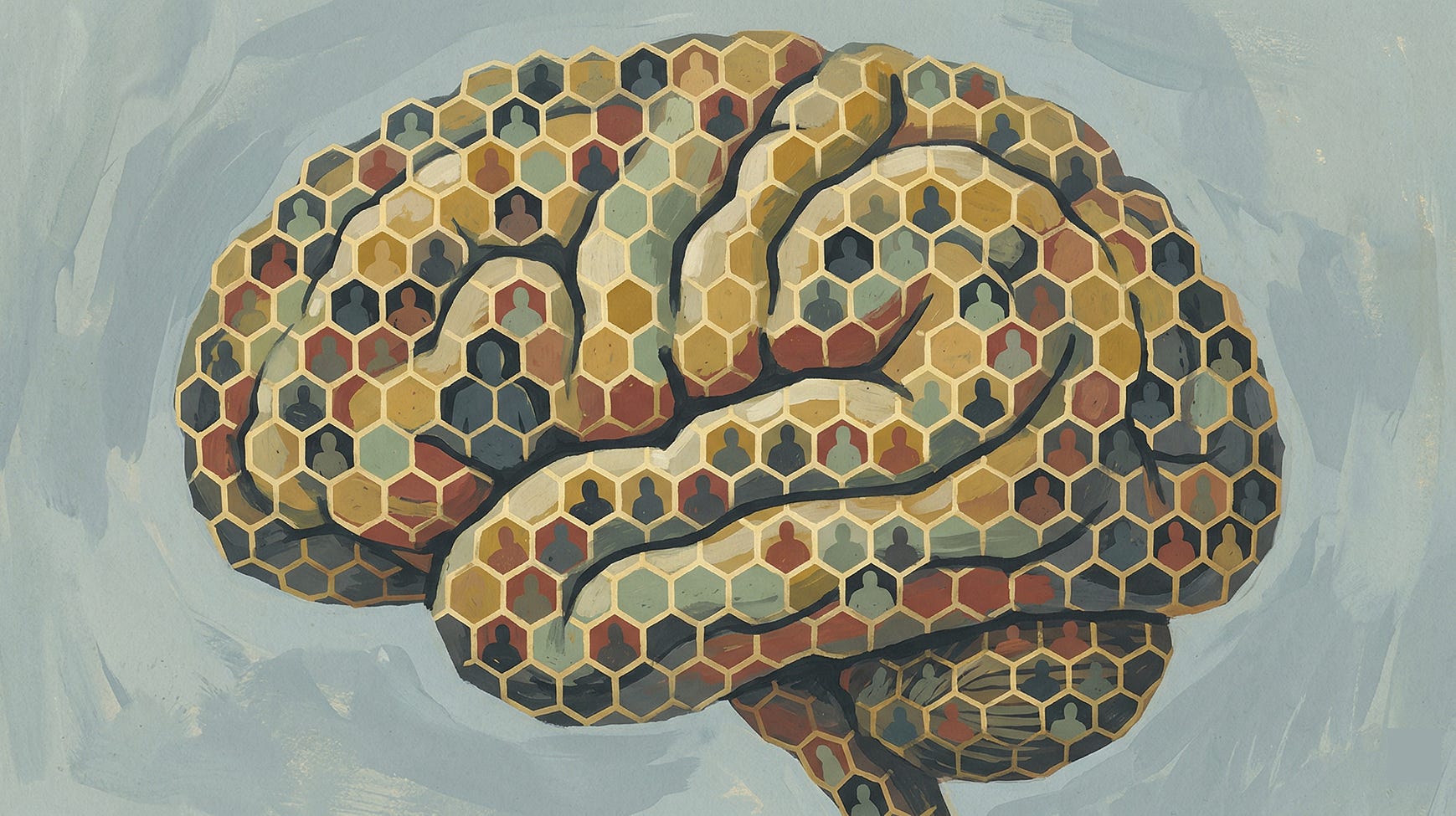
This contradiction is forcing all of us who talk and think and write endlessly about this topic into two polarizing groups. You are either in or outside the hive.
Which group do you belong to? It depends on how you interpret the story I am about to tell you.
But first, I gotta say something real quick.
Provocation of the week
The outsiders are right but they can’t prove it.
I didn’t invent the hive mind metaphor. It came up in a recent ON_Discourse Group Chat I hosted about the philosophy of work. If you cringe at that statement, I can already tell which group is yours.
The event centered on a late 2025 NeurIPS study called “The Artificial Hivemind,” that was referenced by our guest expert. This executive is an AI researcher and brand builder for a Fortune 150 company who needed a safe space to process the big and weird questions that come from the bleeding edge of this tech. We were happy to oblige.
The story that defined our event is the story that will reveal which group you belong to. It all comes from the NeurIPS study. The whole thing reads like a Columbo episode, you already know how it ends, but that’s not the point.
The study demonstrates that AI homogenizes creative thinking into a mediocre average. I’m sure deep down, all of us can agree with that. Just like we can agree that Jack Cassidy is the murderer. The details of the story are what make it interesting.
The study asked 70 different LLMs to come up with a metaphor for time. This prompt resulted in 1,250 different responses that all distilled into one of two identical ideas: time is a river, or time is a weaver. Word for word. Each model came up with one of those two metaphors.
In the minds of the researchers, AI models and logic constitute a hive that standardizes and contains thinking. In a creative world, that is a problem. Imagine asking 70 different people the same exact question. You know for a fact that more than 2 metaphors would emerge. At least one person would call it a flat circle.
This brings us to the great reveal. Are you in or out of the hive? It all depends on how you interpret this report. The hiveminders are the people out there - maybe it’s you - who scoff at this report. It’s obvious, you say. AI is slop. AI is noise. AI is offloading our thinking at a time when we need it the most. Your favorite word is probably slop and you go out of your way to avoid em-dashes in your LinkedIn posts.
The thing about you hiveminders is that you are obviously not wrong. The other thing about you is that you are also tremendously boring and short-sighted. You’re standing on the edge of a new era and complaining about the traffic.
The outsiders have it worse. Their dirty hands are dripping with slop-scrap that they know doesn’t move the needle, yet, but they will not stop trying to figure it out. These are the vibe coders, the AI philosophers, and the comfortably confused tinkerers who can’t prove it but feel it deep down that something big is coming.
The thing about you outsiders is that you are glassy-eyed dreamers. When pressed for details, you get fuzzier and fuzzier. You have no evidence to prove your claims and every single one of your vibe-coded projects is a substandard copy of a product that already exists. You are the person who claims to know a language but can’t translate it when the rubber meets the road. And still, I hate to say it because listening to you people talk gives me a headache, your nonsense is pointing the conversation in the right direction.
So tell me, which group are you in?
What’s Next?
If you have thoughts, feedback, or a perspective worth sharing, reach out: chmiel@ondiscourse.com. You might see your reaction in next week’s edition.
ON_Member Events
ON_Breakfast Club for AI Leaders: UNASSIMILATED
Wednesday, April 8, 9-11am ET
AI is being built right now. The culture is being defined. And if the patterns of the last decade repeat themselves, speed over inclusion, familiarity over expertise, power that protects itself, will be encoded into the infrastructure of the next economy.
We’ve all been part of this. Men who move fast with who they know. Women who play to power, assimilate, or opt out entirely. The loop runs on all of our choices.
Two responses have dominated: change the system from within, or leave and build your own. Neither has been enough. There’s a third path, genuine partnership. Shared power, shared honesty, shared risk.
Our next ON_Discourse breakfast event is for people ready to figure out what that looks like, together. The only price of entry is honesty about your own role in the pattern.
April 8th. One World Trade, 69th floor. If you’re ready to stop performing allyship and start practicing partnership, this is the room.
Speakers:
Katherine von Jan (AKA “KVJ”) is the co-founder and CEO of Tough Day, the AI company pioneering Human Positive AI for Employee Success.
Jenny Fielding is is co-founder and MD of Everywhere Ventures one of the most active global pre-seed investors, having invested in 300+ companies as the first money in
ON_Podcast
Can AI make art?
Dan, Toby, and Chmiel are joined by Carlos "Mare139" Rodriguez — OG ON_Discourse member, graffiti pioneer, fine artist, and cultural theorist — to dig into the question that lit up the ON_Discourse WhatsApp group: when a member called an AI-generated Spotify track the work of "a new artist," it set off a debate about art, authorship, economics, and who gets to hold the gate. Carlos brings five decades of perspective — from NYC hip hop and Style Wars to digital sculpture and 3D-printed B-Boys — to argue that this moment is less a threat to art than the latest in a long line of tools that expand what's possible. Marcel Duchamp's latrine makes an appearance. So does Questlove.